This post is more than 15 years old
Politics move quickly and opinions evolve. There's a good chance I no longer hold some of the opinions expressed in the post below
—Mustapha
❊ It Now All Boils Down To Whether Or Not Hariri Can Impose a Veto
January 26, 2011 · Mustapha Hamoui
The harsh calculus and inner workings of Lebanese sectarianism.
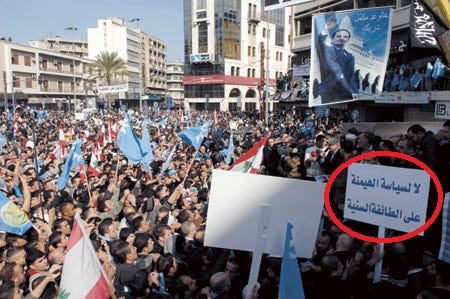
This post is not about whether or not Mr. Hariri has made the right political moves in the last few years (he hasn’t). It’s not about his charisma (needs a lot of work) or current strategy (appears to be missing). It’s not about whether Mr. Mikati is a good or a bad person (good) and it’s not about yesterday’s demonstrations (wrong and terribly embarrassing).
This post is about raw, unvarnished power and sectarianism. It’s not for the politically correct.
There are two kinds of sect Leaders in Lebanon: Those who can impose vetoes, and those who can’t. Until a few days ago, Christians were the only ones who could not impose a veto on leaders they didn’t like. In fact, they were the ones who were most often vetoed for the post of President (Anyone who’s too close to Aoun or to March 14 was immediately vetoed).
The Sunnis (Hariris) and Shiaas (Hezbollah) have exercised their veto rights in the past. Most recently the Shiaa managed to impose a veto on any person other than speaker Berri for the parliament leadership. They pulled that off by walk outs, huge popular mobilization and clever exploitations of constitutional loopholes. Mr. Hariri too, until recently, had the ability to veto anyone he didn’t like for the post of the Premiership (remember when the Mufti prayed by Mr. Seniora when he was surrounded in the Grand Serail by Hezbollah mobs?).
But by having Hariri’s wishes overridden by the installation of Mr. Mikati, has he and the Sunnis effectively been “downgraded” to the veto-less second tier?
Where does the ability to impose a veto come from? As experience has showed us, it’s from the ability to cause a standstill. It’s the ability to say (without saying) that “without me, the wheels of this nation will not turn”. Hezbollah has done it. The Hariris have done it. But the Christians were too divided to pull it off. They once tried to boycott a post-taef election, but they were disregarded and walked over.
Are the Sunnis going to be next? Will they too be balkanized?
Mr. Hariri is now trying his hand at preventing that from happening. He wants to prove that without him, Mr. Mikati will not be able to form a government. Yesterday’s violent demonstrations were a clumsy first attempt, but his supporters are hoping that he’s preparing a less destructive, less P.R. damaging plan. His media outlets are relentlessly pushing the idea the Mr. Mikati is “Hezbollah’s Prime Minister”, with colorful variations sprinkled in now and then like “The Prime Minister Of Wilayat al Faqih”. It’s obvious he has made the strategic decision of confrontation, and the results might make or break his claims for sectarian leadership.
I have always argued that diversity in a sect is a good thing. The Christians have livelier debates, better news websites and arguably a better exercise of democracy. In the event of a Hariri failing, the Sunnis could look to that as a silver lining. But what’s for sure is that many will still begrudge the fact the the Shiaas are now the only ones left with a powerful, united leadership.