This post is more than 13 years old
Politics move quickly and opinions evolve. There's a good chance I no longer hold some of the opinions expressed in the post below
—Mustapha
A Lot to Lose
February 18, 2013 · Mustapha Hamoui
Just hit play. Why a fast internet connection and free tablets are not enough to make Lebanese workers competitive.
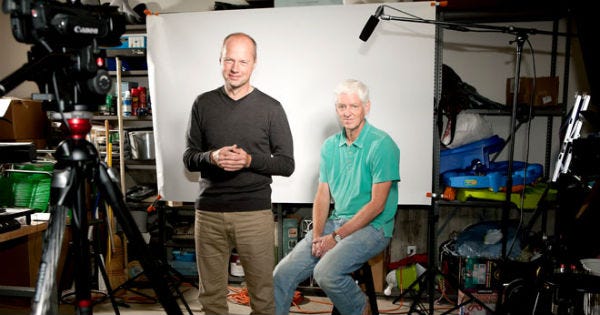
— The new face of education. Stanford professors Sebastian Thrun and Peter Norvig (source) —
My official university degrees are in Business Administration and Graphic Design, but I’ve always been a computer programming enthusiast. I blame a childhood of privilege in which my father thought it was a good idea to invest in a private tutor to teach me “computers” back in the 80s. The tutor who wanted to maximise his billing time decided that the best things for a 10 year old to learn are GW-Basic and dBase, the equivalents of Visual Basic and Microsoft Access today. Other boys played Atari, I was learning loops, arrays, data types and conditional statements.
I ended up as the kid who wrote a “game of the month” program for our school’s newspaper (A warning to aspiring young nerds: A chick magnet that was not). 25 years on, I still love this field, and I kept teaching myself new stuff whenever I can. The last 5 years though were a blast: The combination of Youtube and a fast, cheap internet connection in the country where I live created something of a Cambrian explosion in my learning process. Youtube is shock-filled with free courses, tutorials and material I didn’t even know existed. Free online videos was how I taught myself web standards, HTML, CSS, Javascript, JQuery, PHP, MySQL and other web technologies that I use everyday today.
A revolution we’re missing out on
I indulged in some autobiography here because I believe it is relevant to this post and its message: Millions of people all over the world are using web videos everyday, not only to learn new technologies, but also to update their current knowledge and find out what has become obsolete. Things are changing fast; The talk everywhere is of disruption in education and in the field of learning. Everybody is buzzing about MOOCs (Massive open online courses) . Websites from the Khan Academy to Coursera to Udacity are changing the world.
But Lebanon is missing out on this revolution, with potentially disastrous consequences to the competitiveness of its workforce. Our country has a problem that not only isn’t being solved, but one that is not being acknowledged and with absolutely no plans to address it.
Why Lebanon is falling behind
The other day, I had twenty minutes to kill, so I decided to watch a “tips and tricks” video about GIT (a version-control system). I hesitated for a second, but then said to myself: “I have nothing to lose, just hit play”. It was at this moment that it occurred to me: I would never have said that if I were in Lebanon. The internet there is so precious that I have to monitor my bandwidth and save my YouTube watching to only the essentials. It dawned on me that Lebanon is in a serious mess and that a fundamental change has to take place.
Minister Nicholas Sahnaoui is a well-intentioned man who is working very hard. You can tell from his tweets that a faster internet connection makes his heart sing. He’s one of us, many internet users believe, he wants to speed up the internet and wants every Lebanese student to have a tablet. He’s young and modern and he wants Lebanon to be a “digital hub” for the region because he believes that we have the best knowledge workers around. He’s also trying his best to make the internet fast.
The sad truth though is that even if the internet in Lebanon is very fast, the fastest in the world even, that’s not what is important. What really matters, what makes a big difference is that we have a fast, abundant and cheap internet. The internet should be so fast, so cheap and so abundant that people won’t think twice before hitting play on an online video that could teach them new things. There should be so much internet around that people will casually download 10 ipad educational apps for their kids (1GB each), decide which one they liked most and then delete the others (because they can always download them later). Backing your entire hard drive online should be as casual as eating breakfast. There should be no feelings of guilt for “wasting” the internet. Unlike water, bits can be infinite. And yet because of a short-sighted government policy, the Lebanese still treat the internet like a scarce resource.
We’re doing it wrong
Our governments (both this and the previous one) have a fundamentally flawed understanding of the value of the internet. To them it is a privilege to users and a cash cow to the state, netting the treasury some good money. But this is a very short-sighted view. What the treasury is making in income from an expensive internet, it is losing in loss of competitiveness from our knowledge workers. People everywhere From Bangalore to Tallinn to Santiago are becoming more competitive than us as we speak. And not just in tech; increasingly, reference material in all fields, from medicine to engineering to finance is taking the form of online videos. Surgeons can watch all kinds of rare surgeries online. Universities understand this, that’s why they try to install a fast and free internet on their campuses. But in today’s world education is becoming an ongoing, lifelong undertaking.
Imagine if a few years down the line Lebanon started getting the reputation for having the worst doctors and engineers in the region. The idea is not so far fetched, as we are already falling behind in some fields. Take web design. I look at the source code of some important Lebanese websites and I slap my forehead in frustration. I see things that go back to the dark ages of the web. People everywhere stopped using tables and transparent gifs for layouts, and yet those are still standard practice in high-profile websites in Lebanon, even in those that recently got makeovers. This is the result of people learning something in school and not adapting their knowledge to fast-changing best-practices.
What we need is a serious paradigm shift. The government should think of the internet less as a cash cow and more like a strategic resource that needs to be subsidized if necessary. There’s a reason why the United Nations deemed Internet access to be a human right, and Finland made broadband a legal right. This is not a luxury, this is the entire future of a country.