This post is more than 12 years old
Politics move quickly and opinions evolve. There's a good chance I no longer hold some of the opinions expressed in the post below
—Mustapha
The Age of the Muslim Civil War
January 4, 2014 · Mustapha Hamoui
The Shiaa-Sunni war is only a small part of a larger dynamic
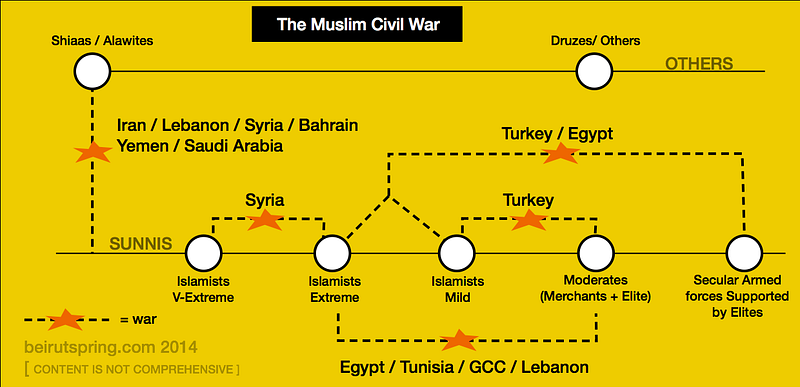
When analysts and observers talk about what’s going on in the region, they like to refer to a large narrative that is shaping war and peace in our neighborhood. The ‘big’ story today is that there is a cold war between Saudi Arabia (Sunnis) on one side, and Iran (Shias) on the other. Since this is a proxy war the fighting takes place in “stages” like Syria, Lebanon and Bahrain. This, consequently is creating the post-Arab-Spring mayhem that we see everyday in the news.
True but Incomplete
A grand narrative has its benefits. It generally simplifies a complex issue and strips away the superfluous details, making it easy for readers to wrap their heads around otherwise difficult-to-understand situations in far away places. But it can also be dangerous, especially when people start seeing all the conflicts from that prism, causing them to ignore other dynamics that are equally consequential.
I was thinking about this today when I learned that an old Library run by a Christian man was burned down in Tripoli, Lebanon (my city). When that happened, two dynamics immediately took shape on Facebook and Twitter: “Moderate Sunnis” from Tripoli started to forcefully denounce this cowardly act against books and our “Christian Brothers” and planning a demonstration in support of Father Srouj. The other dynamic is that those same “Moderate Sunnis” were being accused by the other Lebanese camp (the supporters of Hezbollah), of getting in bed with and turning a blind eye to the kind of people (extremist Sunnis) who harass Christians and burn down their libraries.
This is when it hit me: Hezbollah’s allies were seeing this through the Shiaa-Vs-Sunni prism, but what happened in Tripoli, a city with a large majority of Sunni Muslims, has nothing to do with the Sunni-Shiaa war. It was a classic case of what I call “Egypt-Syndrome”, where Sunni Moderates (Liberals in Egypt-speak) are confronting Muslim extremists over the maltreatment of Christian compatriots. (In fact General Ashraf Rifi’s pronouncements against the “terrorists” who burned the library is awfully reminiscent of the posture of Egypt’s General Sisi). The Sunni-Sunni conflict is in turn a part of a larger trend in the region, from Turkey to Morocco, where Sunnis are fighting Sunnis over how exactly a modern society should conform to a strict interpretation of the Koran in managing its affairs.
The chart I put together (above), while not comprehensive, attempts to show the geographical breadth of the Muslim-Muslim conflict in all parts of the MENA region. The reason why these conflicts started doesn’t matter (take your pick: Arab Spring removing oppressors and giving a space for conflicts to rise, Zionist Meddling, Western Imperialism, whatever suits your fancy). But what is indisputable is that we have entered the age of the Muslim Civil war.